




































by Paul Hellmich,Technical University Munich
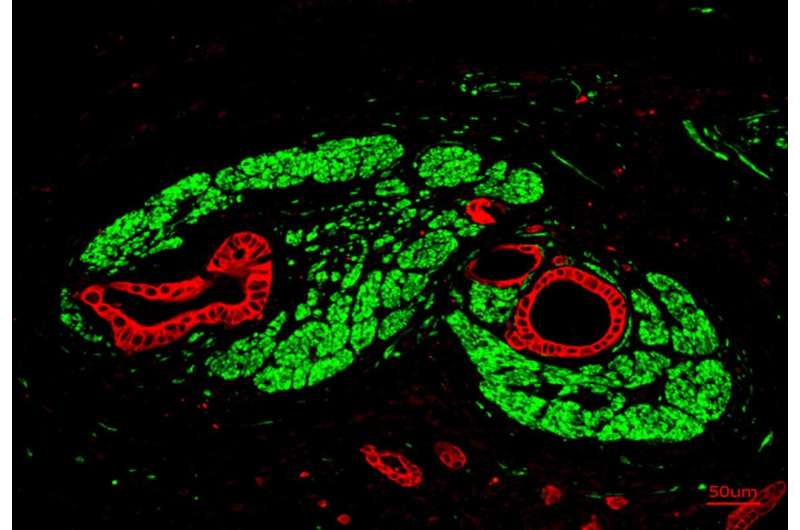
Immunofluorescence image of pancreatic cancer cells that invade nerves: nerve cells appear in green, tumor cells in red. Credit: Ekin Demir / TUM
Pancreatic cancer is one of the deadliest types of tumors. A team at the Technical University of Munich (TUM)reportsthat pancreatic tumors exploit the body's nervous system by forming so-called pseudosynapses.
Through a specific receptor, the cancer cells take up theneurotransmitter glutamate, which drivestumor growth. The researchers now hope to identify drugs that can block this process in patients. The research is published in the journalCancer Cell.
It has been known for some time that thenervous systemcan affect cancer development. For example, nerve cells from healthy tissue can grow into tumors, a phenomenon known as "neural invasion," which is typically linked to a poor prognosis.
About six years ago, a US research group discovered a new mechanism in the brain: tumors can form their own synapses, co-opting neuronal communication for their benefit. Professor Ekin Demir, a clinician scientist at the Department of Surgery at the TUM University Hospital, and his team built on this finding to investigate whether tumors outside the brain might form similar structures.
Pancreatic tumors often show neural invasion. Thus, if such synapse-like structures existed outside the brain, this was the most likely place to find them. The researchers searched pancreatic tumor tissue for clusters of receptors specialized for specific neurotransmitters. In some samples, they did indeed find a strong concentration of NMDA receptors—the receptors that bind glutamate.
Then came the successful search for the characteristic structures of synapses, carried out in the classic way under theelectron microscope. Owing to subtle physiological differences compared with typical neuronal synapses, the researchers refer to these structures as pseudosynapses.
What advantage do pancreatic tumors gain by forming pseudosynapses? Like other glands, the pancreas is regulated by the nervous system. Depending on the body's needs, healthy pancreatic cells receive the neurotransmitter glutamate through their synapses. This triggers a series of processes. Pseudosynapses exploit this natural mechanism.
"When glutamate binds to the cancer cells' NMDA receptors, a channel opens and calcium flows into the cell," explains Professor Demir. "This influx triggers molecular signaling cascades that drive tumor growth and metastasis." The team observed that the cancer cells generate characteristic slow, long-lasting calcium waves that drive tumor growth in a sustained way.
Yet this remarkable mechanism may open up a path to new cancer therapies. In mouse experiments, the researchers successfully blocked the NMDA receptors on tumor cells with a drug. The result:pancreatic tumorsgrew more slowly, developed fewer metastases, and the animals lived longer.
"We are currently using bioinformatic methods to identify approved drugs that, in addition to their primary effects, can also block these specific NMDA receptors inpancreatic cancercells," says Professor Demir. "Therapies targeting the interface between the nervous system and tumors could open up entirely new treatment options."
The team suspects that other tumor types may also form pseudosynapses to accelerate their growth.
More information: Lei Ren et al, Sensory neurons drive pancreatic cancer progression through glutamatergic neuron-cancer pseudo-synapses, Cancer Cell (2025). DOI: 10.1016/j.ccell.2025.09.003 Journal information: Cancer Cell
Provided by Technical University Munich









Post comments