




































byUniversity of Pittsburgh
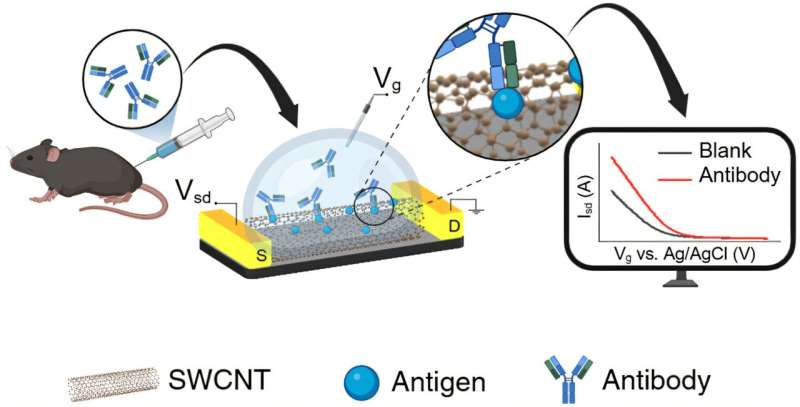
Abstract. Credit:Analytical Chemistry(2025). DOI: 10.1021/acs.analchem.5c03817
A team of researchers at the University of Pittsburgh has developed a skin patch that can detect antibodies associated with COVID and flu infections. It's orders of magnitude more sensitive than existing tests, uses just a half volt of electricity, and can return results in 10 minutes.
Their paper was published online this week. It will be the cover story in the upcoming print copy of the journalAnalytical Chemistry.
Alexander Star, professor of chemistry in the Kenneth P. Dietrich School of Arts and Sciences, has also developed sensors using a similar platform to detect, among other substances, marijuana and fentanyl.
An antibody test can indicate whether a vaccine has successfully taught someone's immune system to fight a specific virus. If a test indicates someone has mounted a strong enough response without a vaccine, they may not need to get a booster.
The sensor uses a virus-specific antigen attached to acarbon nanotube, which is 100,000 times smaller than a human hair. The sensor can be attached painlessly on the skin using a microneedle array which samples the fluids between skin cells. When an antibody binds to its partner antigen, the electrical properties of the nanotubes change, indicating their presence.
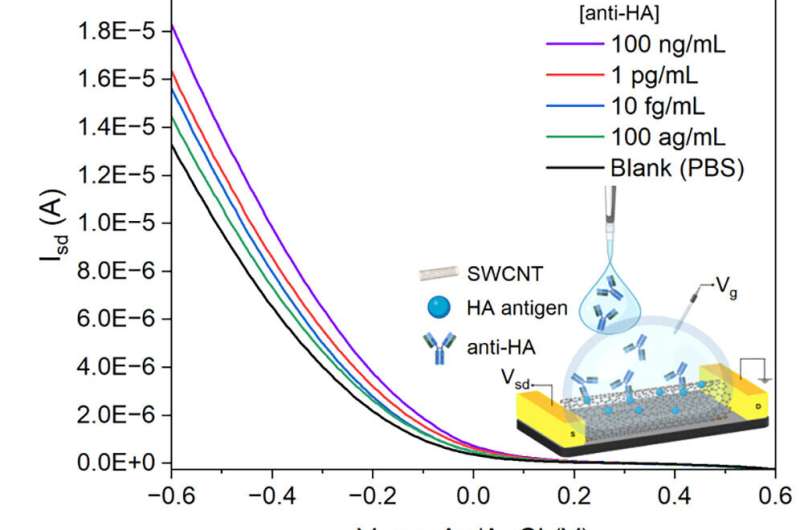
Detection of anti-hemagglutinin (anti-HA) antibody in PBS. (a) FET characteristic curves of a HA-SWCNT FET device upon exposure to an increasing concentration of anti-HA antibody in PBS. (b) Calibration plot for anti-HA detection in PBS (black), testing different concentrations of anti-HA on the nonfunctionalized SWCNT FET sensor chip as a control experiment (blue) and the effect of multiple incubation of the blank on the FET sensor (red). All data points plotted in the calibration plots are mean ± standard error. The number of devices (n) used for sensing is indicated in the parentheses in the legend. Credit: Star Lab
"It doesn't penetrate too deep and so it's not painful," Star said. "It's not touching any nerves and you're not losing any blood, but you are getting the same results."
Beyond SARS-Cov-2 and H1N1, this platform could be configured to identify anyantibodies, including perhaps those associated withautoimmune diseasesin which flare-ups are often triggered by otherwise harmless viral infections.
More information: Amir Amiri et al, Monitoring Vaccine-Induced Antibody Levels Using Carbon Nanotube-Based Field-Effect Transistors, Analytical Chemistry (2025). DOI: 10.1021/acs.analchem.5c03817 Journal information: Analytical Chemistry
Provided by University of Pittsburgh









Post comments